
With the international markets facing uncertainty after Russia invaded Ukraine and Western nations retaliated with sanctions, Indian companies are putting their international fundraising plans on hold as they wait for the markets to recover. Bankers said apart from the geopolitical crisis, international rates are hardening in anticipation of interest rate hikes by the US Federal Reserve to control rising prices in the US. The Ukraine situation has implications for the market. In such a situation, international investors try to shift to safe haven assets by exiting from emerging markets.
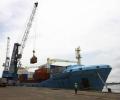
The auditor of ABG Shipyard, which is being probed by the Central Bureau of Investigation (CBI) for the Rs 23,000-crore default to banks, had settled an investigation by the Securities and Exchange Board of India (Sebi) by paying a small settlement fee in 2019. The regulator had initiated an investigation into the fund diversion from ABG Shipyard and had asked the auditor to explain why it failed to detect fund diversion in time. In his settlement application, auditor MN Ahmed, partner of Nisar & Kumar, a chartered accountant firm, said he ceased to be an Indian citizen and has retired from the profession.

With the Adani and Jindal groups and Mukesh Ambani-owned Reliance Industries joining the race to buy Videocon Industries' (VIL's) assets, lenders are expecting aggressive bids for VIL's consumer durables and overseas oil assets, which are to be sold in separate auctions. The entire asset sale exercise is expected to be completed in the next six months, said a banker. A promoter entity of Naveen Jindal-owned Jindal Steel and Power has also evinced interest in the second round of bids for VIL's consumer durable business. The deadline to submit bids for VIL's assets ended on February 2.

A hallmark of some new businesses today is that they seek to use the brute force of capital, combined with smart technology and operations, to create new needs that you didn't even know existed, the chairman of Aditya Birla group said in a blog post on the trends for the new year.

Indian companies are expecting generous tax incentives from the Union Budget that will help them invest more in building capacities in the coming years. While the productivity-linked incentives (PLIs) are a good start to spur local manufacturing, the government should also take steps to boost consumer demand, which is not showing encouraging signs, say chief executive officers (CEOs) of India Inc. Statistics released by the Reserve Bank of India (RBI) shows that Indian banks had sanctioned loans worth Rs 75,558 crore in 220 new projects - a record low - in the pandemic-hit financial year ending March 2021. This is not showing any signs of a significant pick up in the last nine months of the ongoing financial year.

The group began to outperform the broader market only with the onset of the pandemic in March 2020 while earlier it was largely keeping pace with the Sensex. The group's market cap is up 164.4 per cent since the end of March 2020 against a 105 per cent rally in the Sensex.

Larsen & Toubro (L&T), India's largest construction and engineering player, has lost as many as 14 large orders in the country because companies that don't possess adequate technical expertise and experience, of late, have won the projects by bidding lower, claimed A M Naik, non-executive chairman of L&T. But the company has made up for the losses by winning projects overseas, where it has acquired a sizeable market share amid tough competition from large global players, he said.

The Reserve Bank of India's action against Reliance Capital comes at a time when the Anil Ambani group was planning to make a comeback with the group company, Reliance Infrastructure, raising funds from the promoter family. As part of the comeback plan, Reliance Infrastructure received Rs 550 crore fund infusion from the Anil Ambani family. A month earlier, Reliance Power, a listed subsidiary of Reliance Infrastructure, also raised funds from its parent by issuing preferential allotment of shares thus increasing the stake of Reliance Infrastructure in the company.

Tata Sons is all set to acquire a residual stake of 16.33 per cent in AirAsia India from its joint venture (JV) partner AirAsia Berhad for $19 million (or Rs 142 crore) by early next year. The valuation is in accordance with the previous transaction under which AirAsia Berhad had sold its 32.6 per cent stake, said a banking source. Tata Group had increased its stake in AirAsia India at a valuation of $115 million.

The groups plan to take on well-entrenched players like Amazon, Flipkart, and Paytm by merging their offline businesses with e-commerce initiatives.

Amazon violated FDI norms, allege Future Retail independent directors.

Even as the corporate battle over Zee Entertainment Enterprises (ZEEL) has reached the Bombay high court, another Essel Group firm - Dish TV India - is gearing up for a legal battle with YES Bank by planning to move the National Company Law Tribunal to appoint six of its nominees on the board of the loss-making company. While Dish TV said YES Bank has acquired 26 per cent stake by invoking the pledged shares of Essel Group promoter, it also said YES Bank must make an open offer to shareholders of the company, according to the Securities and Exchange Board of India (Sebi) takeover code. This, as YES Bank is seeking to take control of the company, said Dish TV.

India's largest public sector bank State Bank of India (SBI) will support Tata group's bid for soon-to-be-privatised Air India by subscribing to Tata Sons debentures or funding the special purpose vehicle (SPV) set up by Tata Sons for the acquisition. Bankers said the credit rating of Tata group's holding company is "AAA" signifying high safety and a combination of Air India with its existing airline businesses would make it a formidable player - leading to a duopoly market with IndiGo. It would also open many business opportunities, including in the retail segment, an official said.

Vindhya Telelinks, Universal Cables and Birla Cable shareholders go against family's wishes.

Union Minister of Commerce and Textiles Piyush Goyal has stirred up a hornet's nest by taking on India Inc, specifically the Tata group, which is among the companies that lobbied against the Modi government's pro-consumer draft e-commerce policies. While Goyal's comments, made at a Confederation of Indian Industry (CII) event, were streamed live on YouTube, the industry lobbying body later edited the video and subsequently withdrew the entire speech. Goyal had said the Tata group and other Indian companies often lobbied for their interest, while ignoring national interest.

One of Mumbai's biggest real estate redevelopment projects of Bombay Development Directorate's (BDD's) chawls (large buildings divided into many separate tenements, offering cheap, basic accommodation) has taken off in Central Mumbai, opening up a Rs 20,000-crore opportunity for real estate companies. It is expected to drive down real estate prices in Central Mumbai by up to 25 per cent, forecast real estate experts. Spread over 92 acres in Central Mumbai's prime localities of Worli, Lower Parel, and Dadar and consisting 195 four-storey houses, the BDD chawls were constructed in the 1920s.

The Tata group is looking to make a foray into semiconductor (also known as chips) manufacturing and it has set up a business to seize the opportunity, Chairman N Chandrasekaran said on Monday. "At the Tata group, we have already pivoted into a number of new businesses like electronics manufacturing, 5G network equipment as well as semiconductors, in all probability," he said while speaking at the annual general meeting of the IMC Chamber of Commerce and Industry. Chandrasekaran said global supply chains, currently heavily dependent on China, would see a big change in a post-pandemic world with businesses shifting their reliance to other countries.

For the fiscal ended 2021, the group has made a loss of Rs 5,943 crore on sales of Rs 11,723 crore, a drop of 66 per cent over fiscal 2020. The group's total debt was up by 7 per cent to Rs 20,742 crore.

Mumbai, India's financial capital, is set for a mega transformation with a massive patch of land opening up for redevelopment; a new metro railway ready to start services by the year-end; and the country's oldest railway station, the Chhatrapati Shivaji Terminus, going for modernisation with private sector participation. Work on Mumbai's second airport will start from next month, while construction of the sea link connecting central Mumbai to Navi Mumbai has already moved into a fast lane despite Covid-induced lockdowns. Also, a coastal road project, connecting Nariman Point to Worli, is under way and will help decongest the city to quite an extent. Of all these mega infrastructure projects, the one that has a huge potential to change the city's skyline is the Eastern Waterfront project - to be built on the Mumbai Port Trust (MbPT) land.

The Essel group founder, Subhash Chandra has settled 91.2 per cent of his debt with 43 lenders, and the remaining dues are in the process of being paid. "I am happy to report that we have come out of the financial stress situation by settling 91.2% of our total debt to 43 lenders in 110 accounts. "About 88.3% of the amount has been paid, while the remaining 2.9% is in the process of being paid. "We are making all the required efforts to settle the remaining 8.8% of our total debt.
 © 2026 Rediff.com - Investor Information - Advertise with us - Disclaimer - Privacy Policy - Sitemap - Feedback - About us - Terms of use - Grievances